
In today’s world, staying healthy requires more awareness and a proactive approach. There’s another factor most of us rarely think about: EMF protection. Have you ever heard of it? or wondered if it’s something worth paying attention to?
Good health involves managing many areas of our lives. We all know we need to exercise more, eat better, sleep consistently, and maintain a healthy balance between work and rest.
With the rapid advances in technology and the growing number of digital devices that are now part of everyday life, it may also be time to consider how electromagnetic fields fit into the picture and whether they deserve a little more of our attention.
What is EMF?

EMF stands for electromagnetic fields. These are the invisible areas of energy that are created whenever electricity is flowing through a device or wire. Power lines, televisions, laptops, WiFi routers, cell phones, and even household wiring all produce electromagnetic fields.
Do you remember the school science class where you had a small battery, wrapped a wire around a nail, connected it, and it became a magnet? That simple experiment is an example of electromagnetic fields in action.
Most of the time, we don’t think about them because we can’t see or feel them. They are simply part of the environment created by modern technology. The question isn’t whether EMFs exist. The question is how much exposure we have in today’s digitally connected world.
Just like sunlight, which is beneficial in moderation but requires awareness with prolonged exposure, electromagnetic fields are part of our environment. The goal isn’t elimination. It’s understanding and balance.
Technology has advanced rapidly over the last several decades because of our insatiable appetite for it. As a result, our homes now contain more powered equipment than ever before. This naturally increases our overall exposure, the effects of which may not yet be fully understood. For some people, that alone is reason enough to take a closer look.
How I Checked It Out
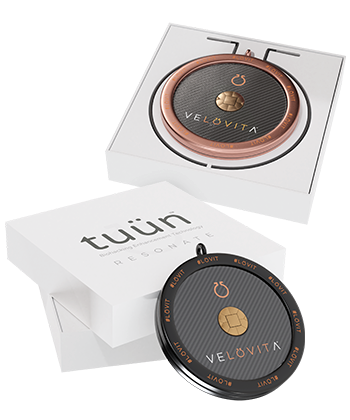
The first time I had heard about EMF protection was at a conference where the Tuün Resonate was first introduced. Until then, I hadn’t given it much thought. After hearing the initial presentations, I decided to get one.
I worked as a software engineer for over 40 years. I also have multiple laptops and monitors in my home office, along with three UPS battery backups. When I got home, I started wondering just how much EMF there might actually be in my house.
So I ordered a simple EMF meter and began walking around with it.
Time to Find Out
I started in my bedroom. The TV was mounted on the wall above a chest of drawers. It was turned off. I stood in front of it and pointed the meter toward the screen.
Beep. Beep. Beep.

The display jumped and turned red. I remember thinking, Wow. The TV isn’t even on.
I pulled out the meter instructions to see what the beep and red light meant. Just what I thought. It was measuring higher levels. No beep means lower levels. Pretty simple.
Out of curiosity, I held the Tuün up in front of the meter to see what would happen. The sound immediately quieted down. It didn’t drop to zero, but it was no longer in the red.
Hmmmm. Really? That much EMF and the TV isn’t even on? I must have done something wrong.
So I repeated the exact same test and got the same result.
Interesting. Very interesting.
With all the talk I had heard about EMFs, computers, laptops, routers, and everything else, I couldn’t help thinking, “Computers, laptops, routers, oh my.” And yet here was just my TV, not even on, lighting up the meter.
More testing…
Now I was really curious. They hadn’t mentioned TVs, especially when turned off, so I moved into my office to see what was happening there.
First, I pointed the meter at one of my laptops. Nothing.
Really? That’s what everyone talks about.
Then I noticed the power block in the cord. I had never really thought about what it was doing. So I pointed the meter at it.
Beep. Red again. Bingo. Or maybe I should say, Beep.
I tried it again with the Tuün. Same pattern as the TV. The sound quieted down, and it was no longer in the red.
Now it’s a game. What else can I test?
How about the UPS battery backups? They’re larger than a laptop power block, so I wanted to see what they would show.
I aimed the meter. Beep. Red light again. There it was.
I tested again with the Tuün. Same result.
Some thinking…
Okay. I just bought this new meter. I had never used one before, so maybe I wasn’t doing it correctly. I went back and tested the TV again, just to be sure.
Same result. A third time. Hmmmm.
Apparently, I am not alone in my office. Who knew? I never suspected there was that much electrical activity in there.
What does it mean?
My first conclusion was simple: there is more electrical activity in my home than I had ever realized. It started with a TV that wasn’t even turned on.
Second, in every test I repeated, the readings changed when I introduced the Tuün. That pattern was consistent across multiple devices.
For me, that was enough to continue using it and to consider other ways to help reduce the exposure.
A Layered Approach to EMF Protection
After all those tests, I had a decision to make. I could ignore it, or I could make a few adjustments. I could also learn more about it.
For me, it wasn’t possible to eliminate technology. That’s not realistic. My office runs on it. My home depends on it. The goal wasn’t to remove electricity from my life, because that would involve living off the grid. It was to be more intentional about how I lived with it.

The Tuün became the first layer. I wear it daily. I sleep with it. It goes with me everywhere. Based on my testing, it consistently changed the meter readings in my environment, so it only made sense to continue using it.
But I didn’t stop there.
I also looked at placement. How much equipment did I really need in my office? And why was I plugging laptops with their own batteries into a UPS anyway? So I moved one of my UPS units out of my office and into the spare room where my broadband modem lives. That removed one large powered device from the space where I spend the most time, and as a bonus, my internet now stays on when the power flickers.

I added two larger BioArc discs in my office, positioning them near the remaining UPS units. I placed a smaller disc inside my phone case. Again, the idea wasn’t to chase numbers. It was to reduce overall exposure where I reasonably could.
I also started unplugging certain devices, like the bedroom TV, when they weren’t in use.
I learned more about EMF, staying in tune with nature, and even the idea of grounding. Eventually, I added a grounding sheet to my bed. Interestingly, my Fitbit data showed less awake time during the night after I started using it. Is that proof? Maybe. Maybe not. But I can say I sleep well, and I’m not taking it off the bed. I also plan to stay grounded by going barefoot in the grass more often and taking more trips to the beach.
For me, this became less about one product and more about a layered, practical approach. Small adjustments. Thoughtful placement. Measured decisions.
Electrical Density Today
When I stepped back and looked at everything I had tested, one thing became clear. It’s not just about one device. It’s about how many powered devices now exist in a single home.
There was a time when most houses had one television, and it sat in the living room. If you wanted to watch something, everyone gathered in the same space. That one TV was likely the largest electronic device in the house.

Today, it’s not unusual to have a television in every bedroom. Add to that laptops, tablets, smartphones, WiFi routers, smart appliances, gaming systems, battery backups, chargers plugged into every wall, and devices quietly running in the background even when they appear to be “off.” Many of these devices are duplicated for each person living in the house, increasing the overall density even further.
None of this is inherently bad. Technology has made life easier, more connected, and more efficient. But it has also increased the overall electrical density inside our homes.
More devices. More wiring. More signals. More constant activity.
For many of us, this shift happened gradually. We didn’t wake up one day and install twenty devices at once. They accumulated over time. One upgrade here. One new gadget there. A second monitor. A second TV. A stronger router. And as children grow up, that often means another full set of devices for them as well.
The question isn’t whether technology should exist. It’s whether we are aware of how much of it surrounds us and whether we are being intentional about how we live with it.
For me, simply becoming aware was the first step.
Do You Need One?
Whether or not you need EMF protection is a personal decision.
I can’t tell you what your home looks like, how many devices you use, or how sensitive you may or may not be to your environment.
What I can say is this: I hadn’t really thought about it either until I tested it.
If your home is filled with multiple televisions, routers, laptops, gaming systems, chargers, and battery backups, you may simply want to become more aware of what’s around you.
- Maybe that means testing your own environment.
- Maybe it means adjusting device placement.
- Maybe it means unplugging a few things at night.
And maybe it means adding a layer of protection.
For me, wearing the Tuün became a simple, practical first step. It didn’t require giving up technology or making dramatic changes. It was one intentional decision that fit into a broader, layered approach.
You don’t have to overhaul your life. You don’t have to be alarmed. But you might decide, like I did, that being intentional is better than being unaware.
If you’re ready to explore it further, you can learn more about the Tuün Resonate and decide whether it’s a good fit for you.
Bebops Lifestyle Treasures™ is where real stories and curious minds come together.
Explore tools, tips, and treasures that help you live smarter, safer, and stronger.
💬 Have questions or feedback? Contact us
📝 If you’d like to stay connected, you’re welcome to Register here.
Last Updated: 3/3/26